Car Overheating: Common Causes, Warning Signs & Solutions
Car overheating is a common concern for drivers, particularly during the UAE’s summer months, when temperatures can exceed 45°C. If left unaddressed, an overheating engine can result in serious damage and costly repairs—potentially turning a simple coolant issue into a major engine repair.
The UAE’s extreme climate can place additional strain on vehicle cooling systems. Prolonged idling in traffic, long highway journeys, and sustained high ambient temperatures can all increase the workload on critical cooling components. Regular vehicle maintenance and timely inspections can help prevent overheating and keep your car running reliably throughout the summer.
At Carcility, we make it easier to get a clear quote and the right service or repair without the usual hassle.
Common Causes of Car Overheating
🌡️ Low Coolant Levels
Coolant absorbs heat from the engine and carries it to the radiator, where the heat is released. When coolant levels become too low—often due to a leak or another cooling-system issue—the engine may struggle to maintain a safe operating temperature.
What to do:
Check your coolant level regularly, inspect for signs of leaks, and use the manufacturer-recommended coolant when topping up.
🔧 Faulty or Damaged Radiator
The radiator plays a crucial role in removing heat from the engine coolant. A radiator that is damaged, corroded, clogged, or restricted may not be able to dissipate heat effectively, causing the engine temperature to rise even when coolant levels are normal.
Warning signs include:
- Rising or fluctuating temperature gauge
- Visible coolant leaks
- Overheating, particularly in stop-and-go traffic
- Reduced cooling-system performance
🚘 Water Pump Failure
The water pump circulates coolant between the engine and radiator, helping maintain a stable operating temperature. A worn bearing, damaged seal, or failing pump can reduce or stop coolant circulation, potentially causing the engine to overheat rapidly.
What to do:
Have your cooling system inspected as soon as you notice unusual temperature increases or signs of a coolant circulation problem. Replacing a failing water pump early can help prevent more extensive engine damage.
⚠️ Thermostat Problems
The thermostat regulates coolant flow according to the engine’s temperature. If the thermostat becomes stuck closed, coolant may not reach the radiator properly, causing the engine to overheat.
Warning signs include:
- Rapid temperature increases shortly after starting
- Inconsistent temperature gauge readings
- Engine overheating despite normal coolant levels
- Poor or inconsistent cooling-system performance
Warning Signs of an Overheating Car
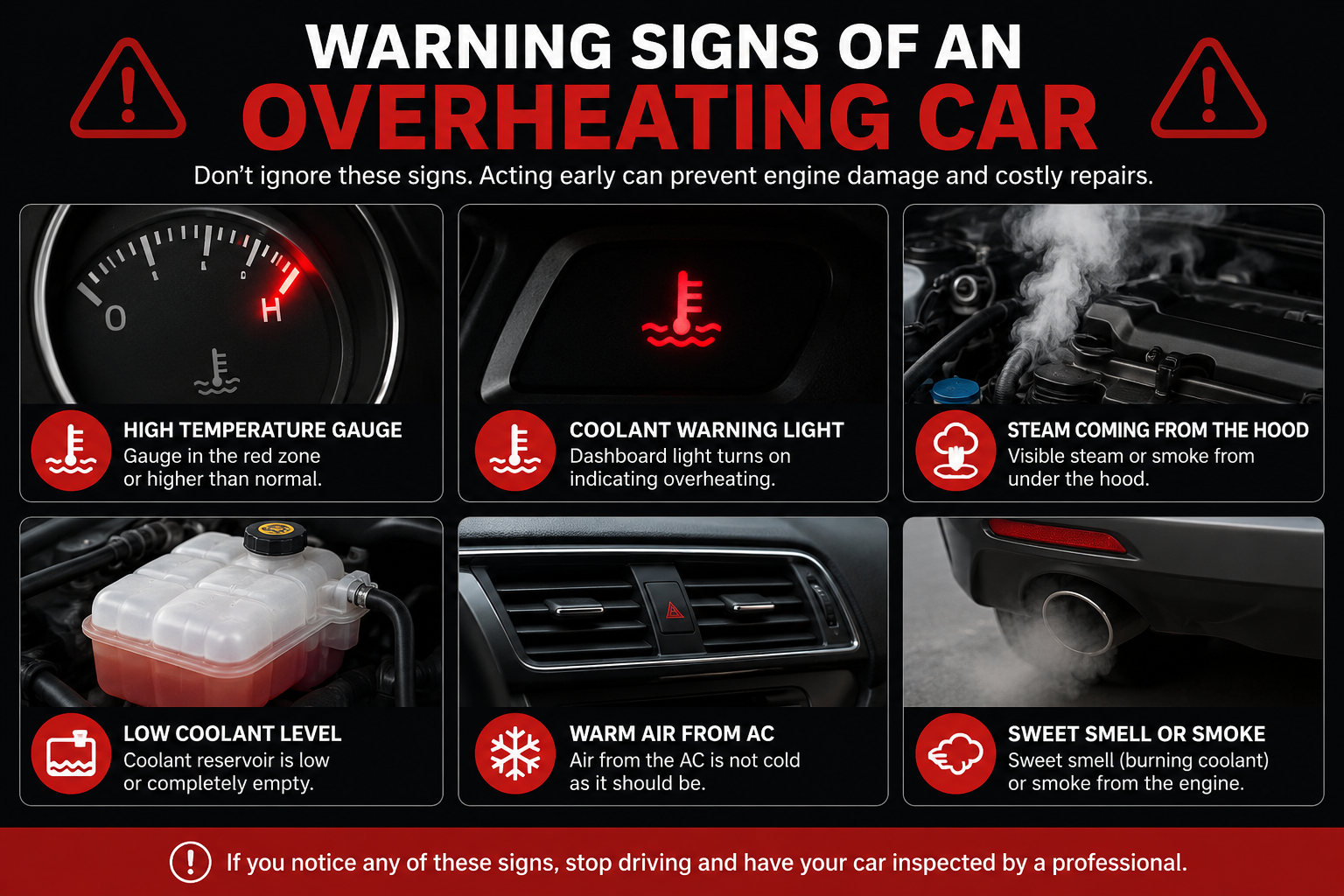
Recognising the warning signs early can help prevent serious engine damage.
Look out for:
- 🌡️ Temperature gauge reading higher than normal
- 💨 Steam or smoke coming from under the hood
- ⚠️ Coolant or temperature warning light on the dashboard
- 🔥 Burning or unusual smells from the engine bay
If you notice any of these signs, stop driving as soon as it is safe to do so. Continuing to drive an overheating vehicle can increase the risk of serious damage, including a warped cylinder head or damaged head gasket.
How to Prevent Car Overheating
Regular maintenance is one of the best ways to reduce the risk of overheating, especially in the UAE’s demanding climate.
Follow these simple steps:
- Check coolant levels regularly, particularly during summer.
- Service your vehicle’s cooling system according to the manufacturer’s recommended schedule.
- Inspect hoses, connections, and the radiator for leaks or damage during routine servicing.
- Address dashboard warning lights promptly rather than ignoring them.
- Park in shaded areas where possible to help reduce heat exposure.
- Consider an Annual Maintenance Contract (AMC) so essential cooling-system checks are included in your scheduled servicing.
FAQ: Car Overheating in Summer
Why do cars overheat more often in summer?
High ambient temperatures, heavy traffic, prolonged idling, and long-distance driving can place additional stress on a vehicle’s cooling system. In the UAE, extreme summer temperatures can make it even more important to keep the cooling system properly maintained.
Can I drive an overheating car?
No. Continuing to drive an overheating vehicle can cause severe engine damage, including a warped cylinder head or blown head gasket. Driving while the engine is overheating can also significantly increase repair costs.
How quickly can overheating damage an engine?
Serious damage can occur quickly once an engine temperature enters the red zone. The risk can be particularly high in hot weather. Pull over safely and switch off the engine as soon as possible to reduce the risk of permanent damage.
Does an Annual Maintenance Contract (AMC) include cooling-system checks?
Cooling-system inspections are commonly included as part of scheduled vehicle servicing, depending on the specific AMC package. Ask about Carcility’s Smart Care and Premium Care plans for details on the services included.
What should I do if my car overheats on the highway?
Turn off the air conditioning and safely pull over as soon as possible. Switch off the engine and allow it to cool before carrying out any checks.
Never open the radiator cap while the engine is hot, as the cooling system may be under pressure and hot coolant or steam can cause serious burns.
Book Cooling System Repairs with Carcility
Don’t wait for a minor cooling-system issue to become a major engine repair.
At Carcility, we can help with:
- Cooling-system inspections
- Radiator repairs
- Coolant leak detection
- Water pump replacement
- Thermostat inspection and replacement
- Complete vehicle maintenance
🚗 Experiencing car overheating or looking for reliable car maintenance in the UAE?
Book your vehicle inspection with Carcility today and keep your car running safely and reliably on UAE roads.
PakarPBN
A Private Blog Network (PBN) is a collection of websites that are controlled by a single individual or organization and used primarily to build backlinks to a “money site” in order to influence its ranking in search engines such as Google. The core idea behind a PBN is based on the importance of backlinks in Google’s ranking algorithm. Since Google views backlinks as signals of authority and trust, some website owners attempt to artificially create these signals through a controlled network of sites.
In a typical PBN setup, the owner acquires expired or aged domains that already have existing authority, backlinks, and history. These domains are rebuilt with new content and hosted separately, often using different IP addresses, hosting providers, themes, and ownership details to make them appear unrelated. Within the content published on these sites, links are strategically placed that point to the main website the owner wants to rank higher. By doing this, the owner attempts to pass link equity (also known as “link juice”) from the PBN sites to the target website.
The purpose of a PBN is to give the impression that the target website is naturally earning links from multiple independent sources. If done effectively, this can temporarily improve keyword rankings, increase organic visibility, and drive more traffic from search results.